

Paris has enough museums to ruin a perfectly good trip. That sounds absurd until you schedule the Louvre in the morning, Musée d’Orsay after lunch, the Orangerie before closing and then wonder why every painting has become a rectangle on a wall. Museum fatigue is real, and Paris rewards selectivity more than endurance.
The solution is to decide what each museum is for. The Louvre gives you the scale of a former royal palace and collections spanning ancient civilisations to European art. Orsay concentrates much of its identity around 19th-century art in a former railway station. The Orangerie is smaller and intensely focused around Monet’s Water Lilies plus a compact modern collection. Smaller museums can provide the personal context that giant collections cannot.
The rule that improves almost every museum day
Plan one major museum and one small cultural stop per day. Treat the second as optional. If the Louvre is your main morning, make the afternoon a neighbourhood walk, garden or river route. If Orsay is your major visit, the Orangerie can work later only if your energy remains high.
This strategy fits naturally into our four-day Paris itinerary. It also leaves time for the neighbourhoods in our Paris neighbourhood guide.
The Louvre: choose a route before you enter
The Louvre is too large for a meaningful “see everything” visit. Choose a theme or a handful of departments before arrival. First-time visitors may prioritise the Denon wing highlights, but ancient Egyptian collections, decorative arts, sculpture and quieter galleries can be equally rewarding.
Timed admission does not mean you will encounter no queues. Security and internal crowding still exist. Arrive with your ticket accessible and a clear first destination. If you spend the first twenty minutes under the pyramid deciding where to go, you have already used the easiest part of your attention span.
Do not make the Mona Lisa your only objective. If seeing it matters to you, do it deliberately, then move into galleries where you can actually look at art without a wall of raised phones. A satisfying Louvre visit can last three hours; it does not need to consume the entire day.
Musée d’Orsay: smaller does not mean short
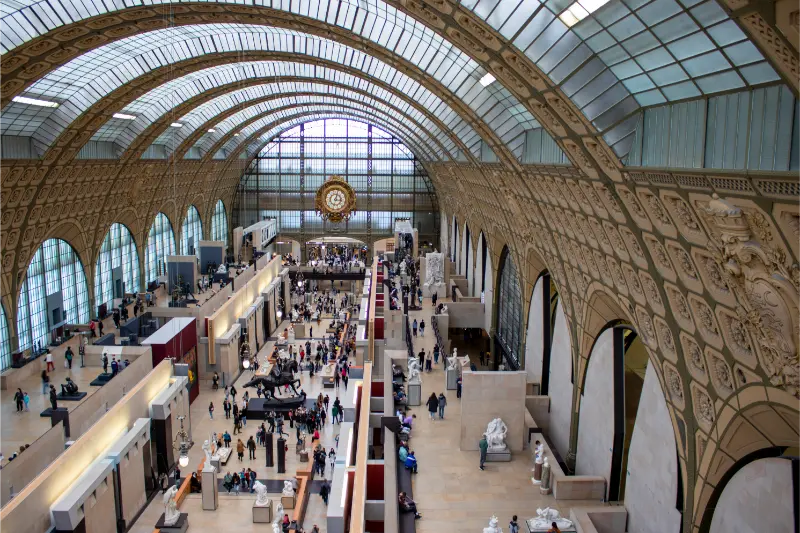
Orsay is physically more manageable, but the concentration of famous works can create its own fatigue. Impressionism draws many visitors, yet the museum’s broader 19th-century collections make more sense when you see how styles connect.
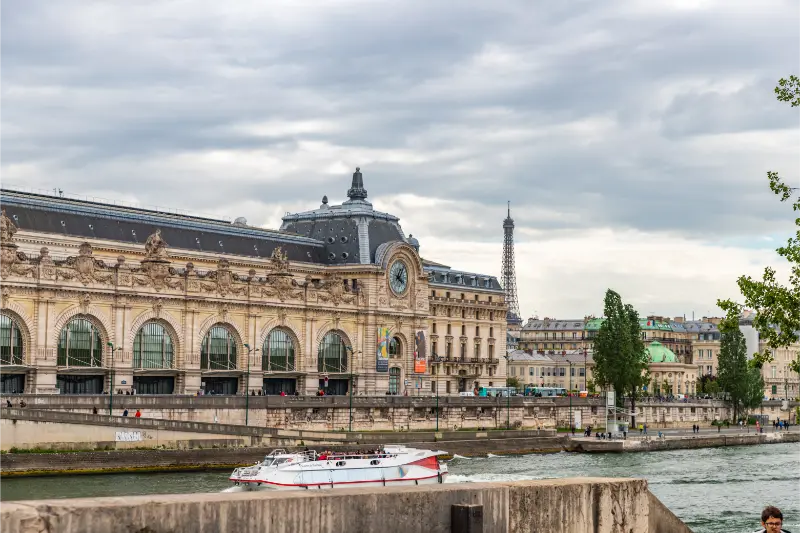
The museum is generally open Tuesday to Sunday, with a late opening on Thursday; always confirm current hours on the official site. Late opening can be useful if you want a slower morning elsewhere. The building itself, a former railway station, deserves attention — especially the great clock and central nave.
Musée de l’Orangerie: use its scale intelligently
The Orangerie is one of the best museums to pair with outdoor time because it sits in the Tuileries and can be visited in a more focused block. Monet’s Water Lilies rooms are designed as an immersive ensemble, not as a collection of isolated canvases. Give them time rather than walking the oval rooms once and leaving.
Timed access may be required or strongly recommended, and temporary exhibitions can create extra queues. Because the museum is small, crowd density matters. Early or quieter slots can transform the experience.
Smaller museums can become the highlight
Paris is rich in museums built around an artist, collector, house or highly specific theme. Musée Rodin combines sculpture with a garden. Musée de la Vie Romantique offers a much more intimate scale. Musée Carnavalet tells the story of Paris. Musée Marmottan Monet can deepen an Impressionism-focused trip without the Orsay crowds.
Choose a smaller museum that answers an interest you already have. Do not add it merely because a pass includes admission. “Free with the pass” still costs time and attention.
Is the Paris Museum Pass worth it?
The Paris Museum Pass includes more than 50 museums and monuments in Paris and the surrounding region, with 2-, 4- and 6-day formats. It covers permanent collections at many major sites, but temporary exhibitions and some special visits are excluded. Reservation requirements can still apply, including at heavily visited attractions.
Calculate value using the places you genuinely plan to visit, not the number you could theoretically enter. A pass saves money only if the included sites align with your itinerary. It can also create bad behaviour: travellers add one more museum at 17:00 “because it is included” when they would enjoy dinner and a walk much more.
Build geographic museum days
The Louvre, Tuileries and Orangerie form one obvious central cluster. Orsay sits across the Seine and can be paired with Saint-Germain-des-Prés or the Rodin Museum. Carnavalet fits naturally with the Marais. Marmottan belongs with Passy and the western neighbourhoods.
Geographic grouping reduces transport and gives your brain a change of activity between collections. Museum, lunch, walk, small museum is much easier than museum, metro, museum, metro, museum.
Where to stay for museum-heavy trips
You do not need to stay beside the Louvre. Central neighbourhoods cost more, and Paris transport makes several areas practical. Use our Paris accommodation-area guide to compare convenience with price.
To check current options, compare accommodation in Paris on Booking.com. For early museum reservations, a direct metro route is often more useful than being geographically central but requiring two changes.
Museum days with children
Do not expect children to experience museums as smaller adults. Choose one story, one room or one object before entering. In the Louvre, that may mean Egyptian animals, a specific sculpture or the medieval foundations. In Orsay, it may mean trains, clocks and a few Impressionist paintings.
Keep visits shorter and add outdoor time immediately afterward. The Tuileries, Seine quays and gardens around museum districts are not wasted time; they are what makes the cultural day sustainable. Our France with kids guide gives more pacing ideas.
Free admission and reduced rates
French and EU museum pricing can include free or reduced admission for certain age groups, residents, disability-card holders and specific categories. Rules differ by institution. Check the museum’s official eligibility page rather than relying on a general Paris blog.
Free-admission days can attract large crowds. Saving an entry fee is not always worth spending extra time in line, particularly on a short trip. If you qualify for free entry, you may still need a timed reservation.
What to do when tickets are sold out
Do not buy from suspicious resellers. First check official same-day availability, late openings and alternative dates. Then switch museums. Paris has enough collections that a sold-out Louvre slot does not ruin a cultural trip.
If Versailles is part of your plan, treat it as a separate full-day experience rather than another museum. Our Versailles day-trip guide explains why the estate needs different pacing.
The best museum itinerary is not the fullest one
Two or three carefully chosen museums over four days can leave a stronger impression than eight rushed entries. Write down the works or rooms you most want to see, then let the rest be discovery. Stop before exhaustion.
Paris’s collections will still be there on another trip. The city outside the museum doors is part of the reason you came.
Official planning links
- Paris je t’aime: Paris Museum Pass
- Musée du Louvre official website
- Musée d’Orsay official website
- Musée de l’Orangerie official website
Keep notes instead of taking hundreds of photos
Museum memory improves when you stop trying to document every room. Photograph labels only when permitted and genuinely useful, then write down the artist or object name in your phone. A three-line note about why something caught your attention is more valuable later than 120 nearly identical gallery photos.
This habit also slows the social-media reflex that can dominate famous rooms. In heavily photographed spaces, step to the side, look first, then decide whether you need an image. You came to see art in person; your camera roll does not need to prove that you stood in front of every masterpiece.
Use temporary exhibitions selectively
Temporary exhibitions can be excellent, but they can also make a museum day much more crowded and expensive. Before buying an additional ticket, ask whether the exhibition genuinely matches your interests. If your main goal is the permanent collection, a blockbuster show may add queues without improving the visit. Conversely, a focused exhibition about an artist you love can justify reducing the rest of the museum to a shorter route.
Read the museum’s own description and room list rather than relying only on promotional headlines. Exhibition dates, reservation rules and included areas change, so treat them as a separate planning decision from general admission.
Build a personal “must-see” list of five works
For a large collection, choose five works, rooms or themes before you arrive. They create a skeleton for the visit without turning it into a scavenger hunt. Once you have seen those priorities, wander for a while and allow unfamiliar art to surprise you. This is far more satisfying than trying to cover every gallery in numerical order.
If one famous work is overwhelmed by a crowd, move on and return later if practical. A museum contains thousands of alternatives. The value of being in the Louvre, Orsay or Orangerie is not measured by how many iconic images you reproduce on your phone; it is the opportunity to spend real time with art that is physically in front of you.
\n\n\nMore Paris planning: Louvre guide · Giverny day trip
\nMore Paris planning: Musée d’Orsay guide
More Paris planning: Musée de l’Orangerie guide · Musée Rodin guide
More Paris planning: Paris Museum Pass guide · Les Invalides guide · Panthéon guide
\n\n\nAnother focused museum: Musée Picasso Paris guide for a smaller art visit that combines naturally with the Marais.
\n