
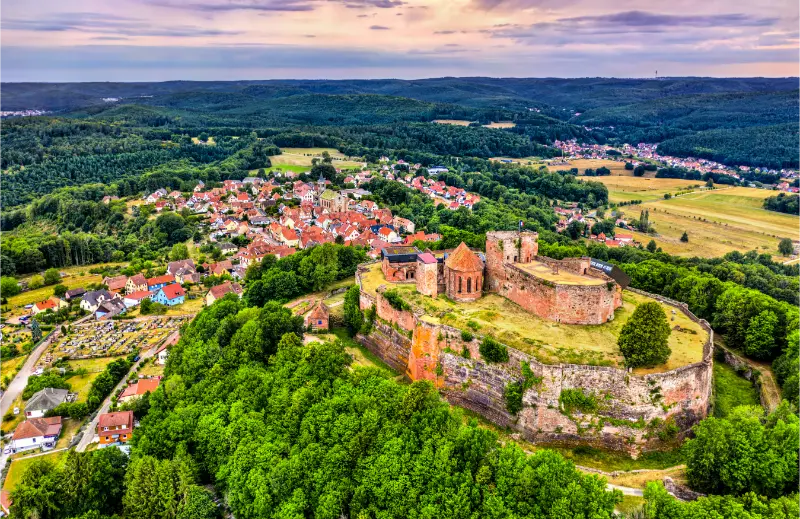
The Northern Vosges are one of the best answers to the idea that Alsace is only vineyards. Forest, pink sandstone, ruined castles and small spa or fortified towns create a landscape that feels much quieter than the central Wine Route.
The regional natural park forms part of the transboundary Vosges du Nord–Pfälzerwald biosphere landscape. Medieval castles were frequently built directly into sandstone outcrops, making the geology and architecture almost impossible to separate.
The GR53 provides the clearest long-distance structure. The park describes five stages between Wissembourg and Saverne, passing places such as Fleckenstein, Grand Wintersberg, Lichtenberg and La Petite-Pierre.
Quick planning snapshot
| Best for | hiking, castles and forest landscapes |
| Ideal stay | 2–5 days |
| Long-distance trail | GR53 |
| High point | Grand Wintersberg, 581 m |
| Good bases | Wissembourg, Niederbronn, La Petite-Pierre or Saverne |
Use the GR53 as a planning spine
The GR53 is marked with the red rectangle and links many of the Northern Vosges’ strongest sites. You can hike the full five-stage Wissembourg–Saverne section or use individual day stages as a framework for a road or rail trip.
Do not underestimate cumulative ascent. The park notes that stage elevation remains accessible but can still approach substantial daily totals.
Grand Wintersberg
At 581 metres, Grand Wintersberg is the highest point in the Northern Vosges. A 25-metre tower adds 110 steps and opens wide views toward the Palatinate, Lorraine plateau, Alsace plain and Black Forest in clear weather.
Cloud and wind can reduce the value of the climb, so keep the summit for the best forecast window.
Sandstone castles
Fleckenstein is the best-known visitor site, but the massif contains many ruins such as Schoeneck, Wineck, Falkenstein, Ramstein and Waldeck. The park publishes circuits linking several of these castles through forest and rock.
Ruins are not standard museum environments: steps, exposed rock and unguarded edges require care, especially after rain.

La Petite-Pierre and Lichtenberg
La Petite-Pierre gives the park a compact fortified centre and houses the regional park’s headquarters in its castle area. Lichtenberg combines a dramatic castle site with a village setting and is another strong stop.
These places work well on poor-weather days because the journey can mix indoor interpretation with shorter walks.
Niederbronn-les-Bains
Niederbronn works as a spa-town base and a practical gateway to Grand Wintersberg and nearby ruins. It is useful for travellers who want restaurants and services without sleeping in an isolated forest location.
Check rail connections if you are building a car-free itinerary; several northern towns are much easier to reach by train than the remote castle trailheads.
New 2026 hiker rest points
In 2026 the park highlighted eight small ‘Üte’ hiker shelters along the Traversée du Massif des Vosges between Rott and Eschbourg. They provide free stopping points, views and interpretation along the route.
These facilities improve the hiking experience but do not replace normal preparation: carry water, food and weather protection.
Plan the Northern Vosges by landscape, not by the Alsace Wine Route
The Northern Vosges are defined by forested sandstone hills, rocky ridges, medieval ruins and small settlements. Their character is very different from the high open ridges of the southern Vosges or the vineyards around Colmar. A sensible trip alternates woodland trails with a castle or a village, giving you time to understand the way rock shelters and defensive sites fit into the terrain. The relatively modest elevations should not be confused with uniformly easy hiking: narrow steps, fallen leaves and damp stone can still make a path demanding.
La Petite-Pierre is a practical base for quiet walking and the regional park’s interpretation, while Niederbronn-les-Bains offers services and routes around the northern hills. Wissembourg is a compelling gateway at the northern end of the long-distance trail. Choosing one base rather than constantly crossing the park is especially important because distances measured in kilometres do not show the bends of woodland roads.
How to use the GR53 without committing to a multi-day trek
The GR53 runs between Wissembourg and Saverne through characteristic Northern Vosges landscapes. The regional park describes a route in five stages passing landmarks such as Fleckenstein, Grand Wintersberg, Lichtenberg and La Petite-Pierre; the main waymark is a red rectangle. Walkers with only one day can choose a shorter signed circuit near one of these stops instead of starting a point-to-point section without return transport. The best route is the one whose finish and way back are both understood before setting out.
Full-stage hikers should inspect elevation profiles, water points, food availability and accommodation opening days. Trail signs are aids, not a guarantee that every path is unaffected by forestry operations. The regional park has also installed small Üte rest shelters at several locations along the route; these are short stopping points rather than a substitute for booked overnight accommodation. Do not assume that open shelters permit camping or fires.
Castles, viewpoints and accessible alternatives
Fleckenstein and Lichtenberg provide two contrasting introductions to the region’s fortified heritage. Fleckenstein’s rock-cut setting makes the relationship between sandstone geology and defence particularly vivid. Lichtenberg has a different architectural story and cultural programme, and visiting arrangements may change according to exhibitions or seasonal opening. Neither site should be approached as a flat museum: there can be substantial stairs and uneven surfaces. Choose the castle that best fits your route and the needs of your group.
For a gentler excursion, select a woodland interpretive route, village walk or scenic viewpoint with verified access conditions. The Grand Wintersberg area offers views but still requires assessing the approach, while La Petite-Pierre combines stone-built heritage with a forest backdrop. Check local information for suitable family routes rather than choosing the shortest line on a digital map.

Wildlife, forest management and low-impact travel
This is a cross-border biosphere landscape rather than empty wilderness. Marked trails coexist with managed forestry, sensitive habitats and local communities. Keep dogs under control, take litter out, avoid gathering plants in protected areas and follow fire restrictions. In autumn, hunting notices and fallen leaves deserve attention; in summer, thunderstorms or hot spells can change the advisability of an exposed climb. A walker who turns back when conditions change is making a sound decision, not losing the day.
The area is suitable for wildlife observation precisely because visitors can move quietly and give habitats space. Avoid attempting to approach animals for photographs and remain on signed public paths. Sunrise or dusk walks can be rewarding but need careful planning so you are not navigating unfamiliar forest in darkness without an appropriate torch and offline map.
Where to stay and three practical itinerary lengths
For a short break, spend one day on a castle-and-village combination and the second on a signed forest circuit. With three days, choose separate northern, central and southern sections only if you have a car; otherwise, concentrate on one base and its surrounding paths. A five-stage GR53 hike requires advance attention to accommodation and baggage logistics, not simply comfortable shoes. The park provides information on luggage transport services, but reservations and operating dates are separate practical matters.
La Petite-Pierre is a strong countryside base, while Saverne and Wissembourg can work as rail-linked bookends. Smaller hotels may have restaurant closing days, so plan food as carefully as walking. Respect trail closures and ask the regional park or local tourist office for the latest route updates before leaving.
Five GR53 stages or one carefully selected circular walk?
The regional park presents the Northern Vosges section of the GR53 as a five-stage crossing between Wissembourg and Saverne. The shape of that itinerary matters: accommodation, meals and baggage transport must be matched to the route endpoints, and some intermediate places have few evening services. A long-distance walker should make those bookings before relying on a fixed daily distance. Weather, forest work and trail conditions can still require adjustments, so carrying a map and having a backup stop are essential.
A visitor with a single day should not simply walk the first kilometres of a stage and hope for an easy public-transport return. Instead choose a signed circular trail near La Petite-Pierre, Niederbronn-les-Bains or a castle that suits the available time and fitness. Ask the local tourist office for current waymarking and access notices. This is particularly important for inexperienced hikers attracted by apparently gentle elevations but unfamiliar with muddy sandstone trails.
Source for additional planning: Northern Vosges Regional Park: GR53 itinerary. Confirm operational details with the venue or transport provider before travelling.
Getting there and getting around
Before locking in the day for Northern Vosges, check the last connection as carefully as the first. Alsace has a dense rail and bus network, but smaller villages and castle areas can have gaps between services. Use current Fluo Grand Est, TER or local tourism information rather than an old timetable.
How long to stay
For Northern Vosges, I would allow enough time to combine the headline sight with the setting that gives it meaning. A rushed one-hour stop may cover the postcard, but it rarely explains how the town, forest, craft or transport story fits into Alsace.
When to go
Where to stay
If Northern Vosges is central to the trip, staying locally gives you quieter mornings and evenings. Use compare accommodation to compare current options, then check the exact location, parking, breakfast and cancellation terms.
Families and accessibility
Northern Vosges can work well with children when the day alternates between one structured visit and open space. Historic paving, castle stairs, forest tracks and old buildings can create access challenges, so check the exact adapted route rather than assuming the principal entrance is step-free.
For younger children, one museum or monument plus a walk, playground, forest stop or market usually works better than stacking several interiors.
Official information to check before you go
For current opening hours, tickets, transport, temporary closures and local events, use Northern Vosges Regional Nature Park. Variable details should always be reconfirmed close to travel, especially for seasonal markets, tourist shuttles, museums and castle sites.
How this fits into an Alsace itinerary
Continue planning with Fleckenstein guide, Wissembourg guide and Saverne guide. For the regional overview, use the Alsace Travel Guide and the 4-day Alsace Wine Route itinerary.
Make room for the forest
Start with the sandstone landscapes rather than a checklist of villages. A morning on a signed forest trail and one unhurried castle stop show why the Northern Vosges feel different from the busier wine-route towns. If visibility is poor, a village museum or a shorter sheltered walk makes a sensible alternative.
In the Northern Vosges, build a day around one clear destination: a castle approach, a stretch of the GR53 or a sandstone village. Forest trails can feel longer than their distance suggests, especially after rain. Leave time to enjoy the views from the ridge rather than squeezing three separate castles into a single afternoon.
Walking conditions in the Northern Vosges
The practical kit here is closer to a short hike than a city stroll. Bring grippy shoes for damp sandstone, a layer for exposed viewpoints and a map saved offline before entering forested stretches. If a castle site has limited access, choose a signed woodland circuit instead of improvising around a closure.
Last updated: 21 October 2026