
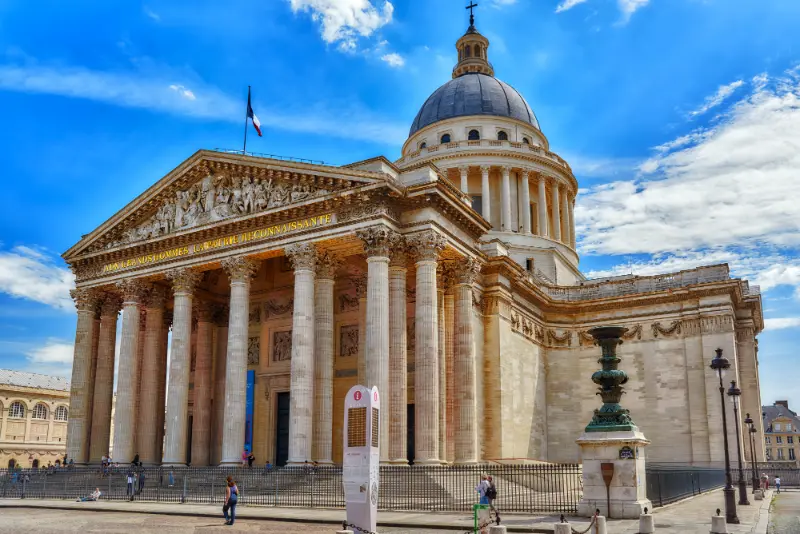
The Panthéon is one of the most rewarding historic interiors in the Latin Quarter because it combines architecture, science, political memory and the stories of people France has chosen to honour. It is also easy to visit badly: some travellers walk into the nave, photograph Foucault’s pendulum, rush through the crypt and leave without understanding why the building matters.
A better visit takes about 60 to 90 minutes and fits naturally into a wider Left Bank day. Check the official Panthéon website for current prices, temporary restrictions and opening times before you go.
What the Panthéon is
The building began as a church dedicated to Saint Geneviève and became, through the political upheavals of modern France, a secular mausoleum for distinguished citizens. Its role changed more than once as regimes changed, which is why the building tells a larger story than its list of famous tombs.
Architect Jacques-Germain Soufflot designed a monumental neoclassical structure whose dome dominates the hill of Sainte-Geneviève. The scale of the nave can feel surprisingly severe after the Gothic atmosphere of Notre-Dame or Sainte-Chapelle.
Why visit if you have limited time?
Visit if you are interested in French history, monumental architecture or the people commemorated in the crypt. The Panthéon is also one of the easiest paid monuments to combine with the Latin Quarter because it sits close to the Sorbonne, Rue Mouffetard, Luxembourg Gardens and several important churches.
Skip it on a very short first trip if your priorities are the Eiffel Tower, Louvre, Notre-Dame and Montmartre. It is excellent, but not compulsory for everyone.
Current opening pattern
The official site lists opening generally from 10:00 to 18:30 between April and September and 10:00 to 18:00 between October and March, with last access before closing. Special closures and delayed openings occur on some dates, and the panoramic viewpoint can close independently.
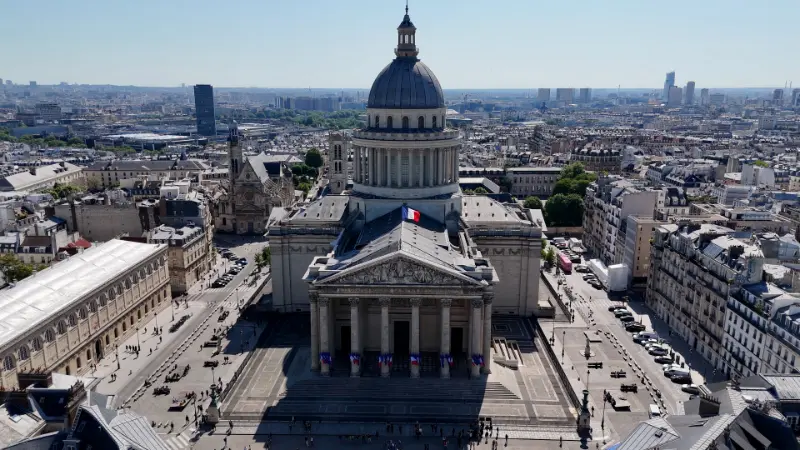
Because conditions can change, especially for the dome panorama, do not build your visit around roof access unless the official site confirms it for your date.
Tickets and the Paris Museum Pass
The Panthéon is included in the Paris Museum Pass under the pass conditions. If you are already using the pass for the Louvre, Sainte-Chapelle, Arc de Triomphe or Versailles, it can be an efficient addition.
Read our Paris Museum Pass guide before buying. Young EU visitors and other eligible groups may qualify for free admission, so check eligibility rather than assuming everyone needs a paid ticket.
Start outside: Place du Panthéon
Do not rush through the doors. Walk around the square first. The elevated position helps explain why the dome is visible from different parts of Paris, and the surrounding institutions give the area a serious academic atmosphere.
Look toward the façades of the Sorbonne quarter and the nearby church of Saint-Étienne-du-Mont. This is one of those parts of Paris where three centuries of architecture can sit within a few hundred metres.
Inside the nave
The first impression is scale. Give your eyes time to adjust and look up before moving toward the exhibits. The interior combines monumental columns, painted cycles, sculpture and ceremonial space.
Rather than trying to decode every work, choose two or three themes: the story of Saint Geneviève, the transformation from church to national monument, and the political meaning of later commemorations.
Foucault’s pendulum
The Panthéon is famous for the experiment associated with physicist Léon Foucault, who demonstrated the rotation of the Earth in 1851 using a pendulum suspended under the dome. A pendulum is displayed in the monument today.
The scientific importance is easier to appreciate if you understand the basic idea before arriving: the plane of the pendulum’s swing appears to rotate as the Earth turns beneath it. You do not need a physics background to enjoy the demonstration, but knowing why it matters turns it from a curious object into one of the most memorable parts of the visit.
The crypt: who is buried here?
The crypt contains the tombs or memorials of major figures from French history and culture. Names include Voltaire, Rousseau, Victor Hugo, Émile Zola, Marie Curie, Alexandre Dumas and Joséphine Baker among many others.
Do not treat the crypt like a celebrity checklist. The choice of who is “panthéonised” reflects changing national values and political decisions. Reading a few biographies before or during the visit makes the space far more meaningful.
Marie Curie
Marie Curie is one of the figures many international visitors recognise immediately. She was interred in the Panthéon with Pierre Curie in 1995, becoming the first woman honoured there for her own achievements rather than through her husband.
Her presence gives a good reason to pause and think about how the institution has evolved. The list of honoured figures is not a frozen record; it continues to change.
Victor Hugo and literature
Victor Hugo’s funeral in 1885 played a major role in establishing the modern Panthéon as a secular national mausoleum. His tomb sits near those of other major writers and thinkers.
If literature interests you, combine the Panthéon with the Le Marais walking route, where the Maison de Victor Hugo stands on Place des Vosges. That creates a better narrative than simply collecting unrelated monuments.
The panorama
When open, the upper panorama adds a view over central Paris, but access conditions are separate and can be seasonal or suspended. The official Panthéon site currently warns that panorama access may be closed, so verify before planning around it.
If you mainly want a skyline, our Arc de Triomphe guide and Eiffel Tower guide offer more dependable major viewpoints.
How long do you need?
One hour is enough for a focused visit to the nave, pendulum and crypt. Ninety minutes is better if you like history and want to read interpretation. Add extra time only if panorama access is available and important to you.
Do not schedule Sainte-Chapelle immediately afterward with no buffer. Walking between the sights is easy, but security and crowds can make exact timing unpredictable.
Best time of day
Morning is good if you want a quiet start before the Latin Quarter becomes busier. Late afternoon can be atmospheric, especially if you continue into Luxembourg Gardens or Saint-Germain for dinner.
On rainy days, the Panthéon becomes an excellent anchor because it gives you a substantial interior visit without committing half a day to a huge museum.
Combine it with the Latin Quarter
The strongest route is geographic. Begin at the Panthéon, visit Saint-Étienne-du-Mont, walk toward Rue Mouffetard, then loop toward the Seine or Luxembourg Gardens.
Our Latin Quarter walking guide gives a fuller route through Roman remains, university streets, markets and the river.
Combine it with Luxembourg Gardens
Luxembourg Gardens is only a short walk away and provides exactly the contrast the Panthéon needs: trees, chairs, fountains and open air after a monumental interior.
This combination works especially well with children or on a trip where you are trying to avoid museum fatigue.
Combine it with Notre-Dame and Sainte-Chapelle
You can build a historic-centre day from the Panthéon downhill toward the Seine. Continue to Île de la Cité for Notre-Dame, then Sainte-Chapelle if you have a timed ticket.
Use our Notre-Dame guide and Sainte-Chapelle and Conciergerie guide. Do not book all three entrances in a tight chain; leave room for walking and lunch.

Accessibility and practical details
The official site notes ramp and lift access for much of the monument, but accessibility can differ for special areas such as the panorama. Standard backpacks are generally permitted, while large luggage facilities are limited. Food and drink are not for consumption inside.
Check the latest practical information if mobility is a concern, because historic monuments often have route-specific limitations.
Photography
Personal photography is generally permitted under the monument’s rules, but tripods and professional shoots require different permissions. Be discreet in the crypt. It is a memorial space, not simply a backdrop.
Common mistakes
- Visiting only for the famous tombs and ignoring the building’s political history.
- Assuming the panorama is always open.
- Booking three major monuments back-to-back with no buffer.
- Skipping the exterior and surrounding square.
- Spending so long reading every panel that the rest of the Latin Quarter disappears from the day.
- Buying a ticket without checking free-admission eligibility.
Where to stay nearby
The 5th and 6th arrondissements are excellent bases if you like walking, historic streets and easy access to the Seine. They can be expensive, but the time savings on a short trip are real.
Our Paris accommodation guide compares these areas with the Marais, Opéra, Montmartre and other bases. You can also compare hotels around the Latin Quarter for your dates.
Is the Panthéon worth visiting?
Yes for travellers interested in French history, architecture, literature and science, especially because it fits so easily into a Latin Quarter day. It is not a place that needs half a day, and that is part of its strength.
Give it enough time to understand the nave, the pendulum and the crypt, then step back outside and continue through one of the most walkable parts of Paris.