

Rouen is one of the easiest Normandy cities to underestimate. Many travellers arrive for the cathedral, take a photograph of Gros-Horloge and continue toward the coast. I think that is a mistake. Rouen works best as a compact two-day city break and as a logical gateway into a longer Normandy itinerary.
Useful planning links: 7-day Normandy road trip · France by train guide · best time to visit France
Why Rouen deserves two days
Rouen is sometimes treated as a quick cathedral stop on the way to somewhere else, but that misses what makes the city work. The historic centre is dense enough to explore on foot, yet layered enough to reward a night: Gothic architecture, half-timbered streets, Joan of Arc history, museums, markets and the Seine all sit within a compact area. The city also makes sense as the eastern gateway to Normandy because trains from Paris Saint-Lazare are frequent enough to make a car-free arrival practical.
The best approach is to separate “monument Rouen” from “everyday Rouen.” See the cathedral, Gros-Horloge and Place du Vieux-Marché, but also give yourself time for Rue Eau-de-Robec, the antiques quarter, a market lunch and the evening light on the old façades. Two days lets you do that without turning the visit into a checklist.
Day 1 morning: cathedral, old streets and Gros-Horloge
Start at Notre-Dame Cathedral before the old centre gets busy. Monet painted the façade repeatedly because its appearance changes with light, weather and hour; standing in the square early makes that obsession easier to understand. Go inside if services allow, then walk the short distance toward Rue du Gros-Horloge.
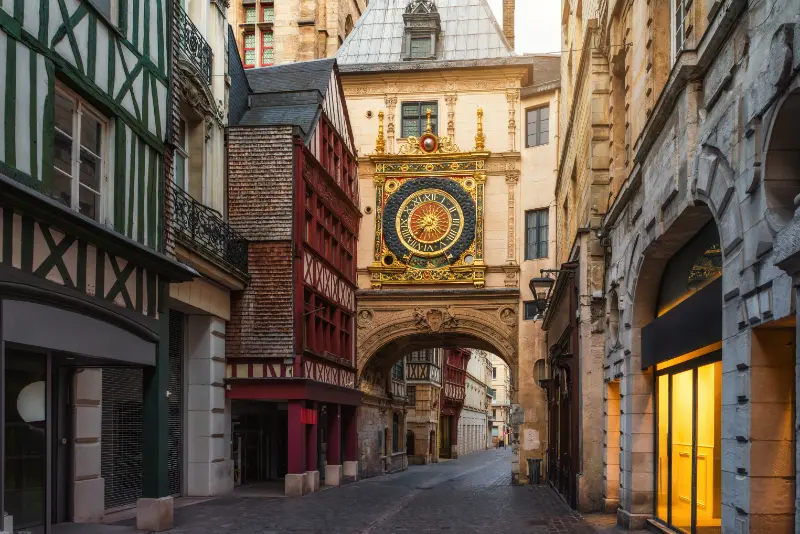
The Gros-Horloge is both a landmark and a useful axis through the pedestrian centre. Instead of photographing the astronomical clock and moving on, slow down around the surrounding lanes. Rue du Gros-Horloge can be busy, but small parallel streets reveal timber-framed houses, courtyards and shopfronts that give Rouen its character.

If you enjoy architectural detail, look for the contrast between flamboyant Gothic stone and the much warmer texture of timber buildings. Rouen is one of those cities where a twenty-minute walk can cover several centuries of urban history.
Day 1 afternoon: Joan of Arc and Place du Vieux-Marché
Walk west to Place du Vieux-Marché, associated with the execution of Joan of Arc in 1431. The modern Church of Saint Joan of Arc deliberately breaks with the surrounding historic architecture. That contrast is worth seeing rather than judging from photographs.
If Joan of Arc is a major reason for your visit, add the Historial Jeanne d’Arc in the archbishop’s palace area. If not, keep the afternoon looser: visit the Musée des Beaux-Arts, browse local shops, or sit down for a proper Norman lunch. Rouen is more enjoyable when one major indoor visit is balanced with time outside.
Day 1 evening: the Seine and a slower old-town loop
Late afternoon is a good moment to walk toward the Seine. The riverfront is not as theatrically beautiful as the medieval centre, but it explains Rouen as a working city and historic port. Return through the centre for dinner rather than staying only on the quays.
In summer, Rouen often stages evening events and illumination programmes around major monuments. These change by year, so treat them as a bonus and check the current calendar instead of planning the whole trip around an old timetable.
Day 2 morning: Saint-Ouen and Rue Eau-de-Robec
Start the second day around the Abbey Church of Saint-Ouen and the gardens behind the Hôtel de Ville. The building is enormous and often quieter than the cathedral. From there, continue toward Rue Eau-de-Robec, where the narrow watercourse and historic façades create a different atmosphere from the main shopping streets.
This eastern side of the centre is where I would deliberately stop navigating for a while. Walk, look into side streets, and allow a café break. The point is to feel the city rather than maximize a list of monuments.
Day 2 afternoon: museum, market or panorama
Choose one priority. Art lovers can devote more time to the Musée des Beaux-Arts. Food-focused travellers can build lunch around a market or cheese shop. If the weather is clear and you have a car or taxi, a higher viewpoint outside the immediate centre can give context to the Seine valley.
Do not try to add Étretat, Honfleur or the D-Day beaches to this same day. Normandy looks small on a map, but moving between its coastal zones takes time. Rouen works best when it is allowed to be a destination rather than a lunch stop.
How to get to Rouen from Paris
Paris Saint-Lazare is the usual departure station for Rouen. Timetables vary by day, so check SNCF close to travel. For a car-free Normandy trip, Rouen is a strong first or final base, but cross-region train journeys toward Bayeux can be less intuitive than the Paris connections; sometimes the most efficient service involves Caen or limited direct regional trains.
If you are renting a car for a wider road trip, consider picking it up after exploring Rouen rather than driving into the historic centre on arrival. That can save parking stress and makes the pedestrian core easier to enjoy.
Where to eat and what to try
Rouen is a good place to start tasting Normandy rather than waiting for rural cheese country. Look for menus using local cream, apples, cider, cheeses and seasonal seafood. Duck is associated with the city, but you do not need a formal restaurant to eat well.
At lunch, a market, boulangerie and cheese shop can be more useful than a long tasting menu if you still want to sightsee. At dinner, slow down. Normandy’s richer cooking makes more sense when you are not rushing directly to the next attraction.
Common mistakes to avoid
- Visiting only the cathedral and saying you have “done” Rouen.
- Driving into the pedestrian centre before checking hotel parking.
- Trying to combine Rouen and the D-Day beaches as one comfortable day trip.
- Assuming an old light-show schedule still applies in 2026.
- Eating every meal on the busiest tourist street instead of exploring nearby lanes.
- Ignoring rain planning: Rouen is still enjoyable in wet weather if you mix churches, museums and cafés.
A realistic two-day schedule
- Day 1: cathedral, Gros-Horloge, old-town streets, Place du Vieux-Marché, one Joan of Arc or art visit, Seine walk and dinner.
- Day 2: Saint-Ouen, Rue Eau-de-Robec, market or museum, relaxed lunch, final neighbourhood walk and onward travel.
This schedule is intentionally light. It gives you room for a closed church, a rainy hour, a market discovery or simply spending longer than expected in one street. That flexibility is what turns Rouen from a transit stop into a memorable first Normandy base.
Planning Rouen in different weather
On a dry day, prioritise the pedestrian lanes, riverfront and outdoor architectural views early. If rain settles in, Rouen is unusually forgiving because major churches, museums, covered cafés and short walking distances let you keep the day coherent. Carry a compact umbrella rather than abandoning the old centre.
In winter, daylight is shorter and timber façades can feel darker, so put the cathedral and streets in the brightest part of the day. In summer, use the long evening for the Seine and old-town atmosphere, when day visitors thin out.
Who will enjoy Rouen most
Rouen is especially rewarding for travellers interested in architecture, medieval history, Joan of Arc, Impressionism and city photography. Families can manage it well because distances are short, though cathedral-heavy itineraries need breaks. Travellers whose main goal is beaches should still consider one night here rather than treating it as a detour.
Practical planning checklist
For Rouen, fix the arrival rail service from Paris Saint-Lazare, then plan a central walking loop rather than repeated taxis. The walk between Rouen Rive Droite station and the cathedral crosses useful parts of the city, but anyone with bulky luggage may prefer to leave bags at the hotel first. Check the exact opening day for the Gros-Horloge interior if you want to go beyond the street view. The Musée des Beaux-Arts and the Abbey Church of Saint-Ouen each make sense as half-day anchors, yet their schedules are independent. Rouen’s historic lanes are most enjoyable when one indoor visit is balanced with enough daylight for the timber-framed streets.
In wet weather, start at the Musée des Beaux-Arts and move through covered or shorter streets toward the Gros-Horloge district when rain eases. A dry afternoon is ideal for the Rue du Gros-Horloge, the cathedral façade and the riverfront, while Saint-Ouen’s surroundings reward time even without a formal visit inside. Rouen has a different character from Normandy’s coastal towns: mist on the Seine is part of an urban landscape, not an invitation to add a beach excursion. If you are travelling in winter, remember that earlier darkness affects outdoor photography long before a museum closes.
Keep Rouen as a genuine overnight base rather than changing hotels between every Normandy stop. The city’s centre has enough dining and cultural choice to reward an evening, and the station is useful for onward rail travel. A visitor heading to Bayeux or Caen should check the current connection instead of assuming every Normandy town lies on a direct line. If you arrive by car, choose a hotel with confirmed parking outside restricted central streets and explore on foot. The best overnight arrangement lets you see the old town in morning light without navigating rush-hour traffic or hauling luggage along its busy pedestrian axis.
Where to stay
For Rouen’s two-day itinerary, look first around the cathedral, the Gros-Horloge corridor or within manageable walking distance of Rouen Rive Droite station. The old centre is convenient for restaurants after sunset, while station-side accommodation can work for an early train. A family with a stroller should ask about lifts, stairs and narrow access rather than relying only on a map showing a short walk. If driving, check garage height, opening hours and the exact route through one-way streets. Compare live accommodation options for your dates via compare current accommodation options and prices on Booking.com, then decide based on where your first morning begins rather than a small nightly price difference.
Final thoughts
Give Rouen at least one night if your schedule allows. The city has enough headline history for a first-time visitor, but its real strength is how easily those monuments connect to normal streets, cafés and neighbourhood life. It is the kind of place where slowing down by two hours improves the trip more than adding another attraction.