
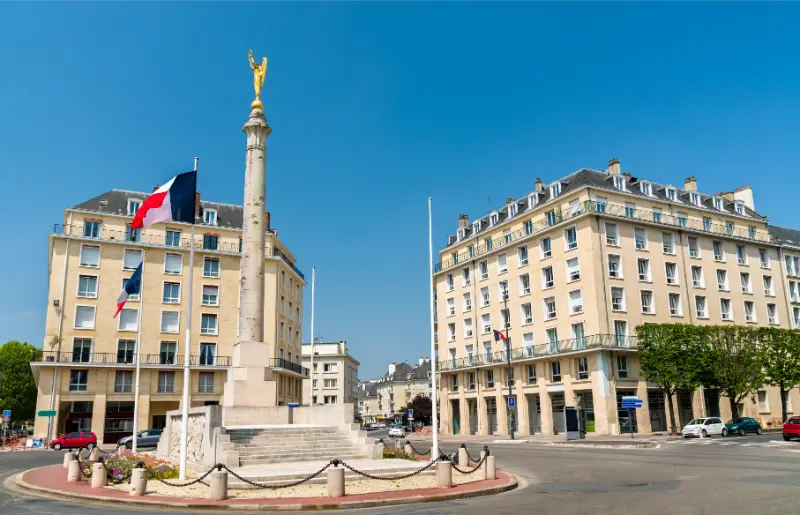
Caen is one of Normandy’s most useful bases because it combines two very different stories: the world of William the Conqueror and the destruction and memory of 1944. It is less postcard-perfect than Bayeux, but often more interesting than travellers expect.
Useful planning links: D-Day itinerary · Normandy road trip · France by train
Why Caen is different from Bayeux
Caen and Bayeux are close enough that travellers often treat them as interchangeable bases. They are not. Bayeux feels smaller and more preserved; Caen feels like a living regional city rebuilt around major medieval remains. Caen is stronger for William the Conqueror, large museums, universities, transport connections and a wider choice of restaurants and hotels.
It also carries visible scars of 1944. Understanding that destruction makes the surviving castle and abbeys more meaningful. Two days is enough for a first visit, but only if you resist the temptation to spend the entire time inside the Mémorial de Caen.
Day 1 morning: Château de Caen
Start at the castle founded by William the Conqueror. The vast enclosure sits in the centre of the city and works as an orientation point as much as a monument. Give yourself time to walk the ramparts and courtyards before choosing an indoor museum.
The castle area is a good place to understand how medieval Caen relates to the modern city rebuilt around it. Because restoration projects and museum access can change, check current on-site information rather than relying on a fixed route from an old guide.
Day 1 afternoon: Abbaye aux Hommes and William the Conqueror
The Abbaye aux Hommes is one of Caen’s essential sites. The abbey church contains the tomb of William the Conqueror, and the surrounding monastic buildings help explain the political ambition behind 11th-century Caen. In 2026, opening patterns vary by season and day, so verify the timetable before you cross the city specifically for an interior visit.

Afterward, walk through central Caen rather than immediately taking transport. The rebuilt streets, surviving churches and café areas show a city that is not preserved in the same way as Bayeux—and that difference is part of the reason to visit both.
Day 1 late afternoon: Abbaye aux Dames
Across the city, the Abbaye aux Dames is associated with Matilda of Flanders, William’s wife, whose tomb is in the abbey church. The park behind the complex offers an elevated view and a calmer finish to the day.
Doing both abbeys in one day creates a coherent medieval theme. If you prefer slower travel, split them across two mornings and spend more time in neighbourhood cafés between visits.
Day 2: Mémorial de Caen without museum fatigue
The Mémorial de Caen is substantial. The museum itself advises an average visit of around four hours, and in the main 2026 season from April through September it opens daily from 09:00 to 19:00. That is a clue: do not schedule it as a ninety-minute stop before three landing beaches.
Arrive early, take breaks and decide beforehand how deeply you want to engage with the galleries. The museum covers more than D-Day, placing the Second World War within a broader story of conflict and peace. For many visitors, half a day is the right amount of time.
After an emotionally dense museum, keep the remainder of the day simple. A meal in town, a park or a short walk is often better than driving directly to another war museum.
Can Caen be a base for the D-Day beaches?
Yes, especially for travellers arriving by train or those who want a larger city base. Caen is closer to Sword and Juno sectors than Bayeux, while Bayeux is often more convenient for Omaha and the American Cemetery. The best base therefore depends on which history you want to explore.
If you plan to take an organized tour, compare departure points before booking accommodation. If driving yourself, build geographically coherent days rather than zigzagging across the entire coast.
Getting to Caen and moving around
Trains from Paris Saint-Lazare make Caen one of the easiest Normandy cities to reach without a car. The station is south of the historic core, and local public transport connects the main areas. For a city-only stay, you do not need a rental car.
A car becomes useful when you move into dispersed coastal sites, rural cheese country or smaller villages. One sensible strategy is to spend the first day car-free in Caen, then collect a vehicle for the onward road trip.
Food and evening life
Caen is a better food stop than travellers sometimes expect because it is a real regional city, not a small heritage centre dependent entirely on tourism. Try Norman cheeses, cider, seafood and cream-based dishes, but also give yourself permission to eat something lighter between rich meals.
Tripes à la mode de Caen is the famous local dish, but it is not compulsory homework. If offal is not your thing, choose seafood, a galette, local cheese or a cider-focused meal instead.
Mistakes to avoid
- Scheduling the Mémorial de Caen for only one hour.
- Using Caen and Bayeux as if they offer the same experience.
- Driving into the centre for every short transfer when walking or public transport is easier.
- Trying to do the Mémorial plus Omaha, Utah and Mont-Saint-Michel in one day.
- Ignoring the medieval abbeys because the city is associated with 1944.
- Assuming opening hours for abbey buildings are identical every day of the year.
A balanced 2-day itinerary
- Day 1: Château de Caen, central streets, Abbaye aux Hommes, late-afternoon Abbaye aux Dames and dinner.
- Day 2: Mémorial de Caen in the morning and early afternoon, then a light local programme or onward travel.
If you have a third day, use it for one focused coastal sector rather than packing the D-Day beaches into your city days.

Caen with children
The castle grounds help break up museum time because children can move outdoors between historical stops. The Mémorial de Caen has substantial content, so families should choose sections carefully rather than assuming every gallery will hold a younger child’s attention for four hours.
A good family rhythm is castle in the morning, lunch, one abbey and a park on day one; then a shorter, focused museum strategy on day two.
Caen versus a coastal base
Stay in Caen when transport, museums and evening choice matter. Stay on the coast when sunrise, beach walks or a specific D-Day sector is the main purpose. Trying to use a seaside village as a base for everything can create repeated driving; trying to use Caen for every western coastal stop can do the same.
Practical planning checklist
The central Caen itinerary needs two independent time checks: the museums within the Château de Caen complex and the Mémorial de Caen. The castle grounds and cultural venues may have different access rules, so do not treat an open gate as proof that every museum is open. The Mémorial is substantial enough to deserve several hours, especially when you want to understand the Second World War context before visiting D-Day sites. Check any temporary exhibitions and tickets separately, then plan an unhurried evening around the centre. Add the Abbaye aux Hommes and Abbaye aux Dames on the day devoted to medieval Caen rather than trying to fit every monument around the Mémorial.
A rainy day is not a disadvantage in Caen if you are prepared to spend it at the Mémorial or one of the museums in the castle grounds. Clear weather suits exploring the castle’s vast enclosure, the streets between abbey complexes and the riverfront. Normandy’s coast is a separate excursion; do not expect an urban tram ticket to carry you to every landing beach and cemetery. For an outing to Ouistreham or the beaches, check regional transport or book an appropriate tour based on your chosen destination. The most relaxed second day avoids switching repeatedly between heavy wartime interpretation and unrelated sites.
Caen is a regional transport base, not only a stop on the way to Bayeux. The railway station and tram network simplify local journeys, while the city offers more choice for evening meals and wet-weather attractions than some smaller coastal towns. A family or group without a car should choose accommodation with easy public transport rather than relying on an optimistic walking estimate across the city. If you plan D-Day excursions, confirm where the operator collects passengers; a pickup in Bayeux is not the same as one in Caen. Three nights can work well if one day is dedicated to the city and the next to a clearly defined historical sector.
When to visit Caen
Caen is a year-round city, which makes it a useful anchor when coastal weather is uncertain. Late spring through early autumn gives you longer opening windows and easier evening walks, while winter can work well for museums, abbeys and restaurants. The Mémorial’s schedule changes through the year, so always check your actual date rather than memorising one set of hours.
June can be especially meaningful because of D-Day commemorations, but that significance comes with crowds, ceremonies, road controls and heavier demand for guides. If you are not travelling specifically for the anniversary period, May, September and October can offer a calmer balance.

A third day in Caen
With three days, do not simply add more museums. Use the extra day to choose one coherent excursion: Juno and the Canadian sector, Bayeux and the western history, or the coast around Ouistreham and Sword Beach. Which one is best depends on your interests, not on a generic ranking.
Another option is to keep the day urban and slower: market shopping, the castle museums, neighbourhood cafés and a longer dinner. Caen becomes more enjoyable when it is allowed to function as a city rather than only as a launchpad for war history.
Where to stay
For Caen, look at the connection between your hotel, the station and the tram route before choosing a room. The central area is useful for the castle, abbeys and restaurants; a station-side base is easier for an early intercity departure but may place some attractions farther away. If you intend to visit the Mémorial, check the best public transport connection for your exact travel day rather than assuming it is a short stroll from the medieval centre. Ask about parking if you are driving and possible noise near major roads. Compare availability for your own dates via compare current accommodation options and prices on Booking.com, while treating ease of movement as part of the nightly cost.
Final thoughts
Caen makes sense when you let its layers sit next to each other: medieval ambition, wartime destruction, reconstruction and modern student life. Two days gives those layers enough room to register without exhausting yourself.